
The Neuroscience of Social Pain
One of the most striking findings in neuroscience is that the brain processes social pain using many of the same neural circuits involved in physical pain. A harsh comment or a moment of exclusion can activate the same distress pathways that respond to a burn or a bruise. We tend to treat social pain as something people should “get over,” but biologically, the brain registers threats to belonging as threats to survival.
For early humans, survival required close social interdependence. Small bands pooled labor, shared resources, and relied on one another for protection. Exclusion wasn’t a social slight. It posed a genuine immediate threat to one’s life. The human stress response still carries that imprint, compelling us to experience threats to belonging as if they remain highly consequential.
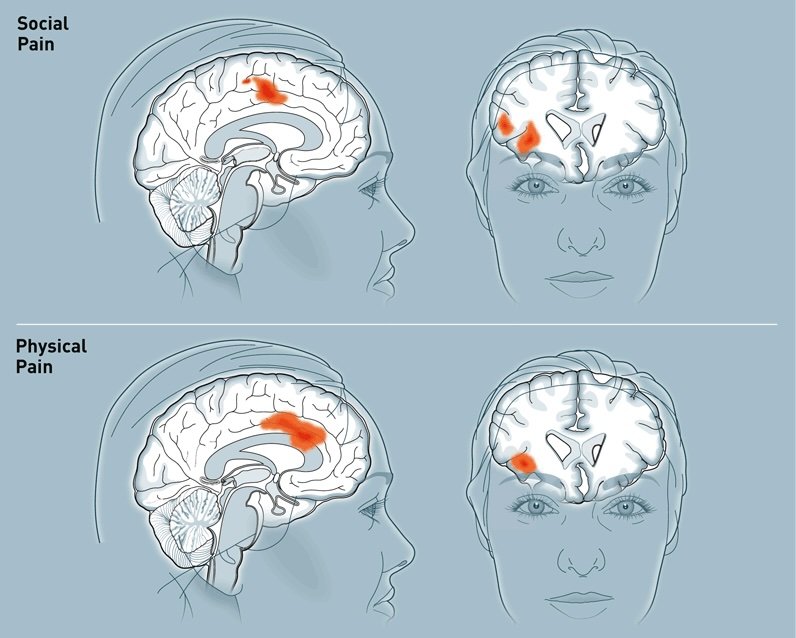
Image: Physical Pain Brain Responses:
These side-by-side fMRI scans reveal how the brain processes social and physical pain along the same pathways. The left images show the dorsal anterior cingulate cortex signaling distress. The right images highlight the right ventral prefrontal cortex working to regulate that distress.
Illustration: Samuel Valasco
Source: Eisenberger, Lieberman, and Williams, Science, 2003 (social pain images): Lieberman et al., "The Neural Correlates of Placebo Effects: A Disruption Account," Neuroimage, May 2004 (physical pain images)
The SCARF Model
David Rock, a researcher who studies how neuroscience informs leadership and behavior, developed the SCARF Model. This framework identifies five social domains the brain treats as threats or rewards:
Status: our sense of relative importance
Certainty: predictability and clarity about the future
Autonomy: control over decisions that affect our work
Relatedness: feeling safe and connected to others
Fairness: the sense that interactions and decisions are just
These domains are not abstract. They map directly onto the brain’s threat circuitry. A hit to status or fairness can activate real distress. A loss of certainty or autonomy can produce strong reactions rooted in the biology of threat detection. Like a knee-jerk reflex, the response to a social threat is automatic. The neural cascade precedes conscious reasoning. The pain registers before we can interpret it.
Why This Matters in Practice
Most conflict and resistance isn’t about the stated issue. It reflects a SCARF trigger, an internal pain signal the person may not be able to articulate. When we understand this, behavior becomes easier to interpret. The defensive colleague isn’t being dramatic. Their sense of status has been unsettled. The resistant team isn’t being difficult. Their certainty has collapsed. The disengaged employee isn’t genuinely apathetic. Their autonomy has narrowed, and they’re feeling the strain.
When we recognize social pain for what it is, deeply wired, instinctual distress processed at a biological level, our approach to leadership, communication, and change shifts. Challenging reactions become indicators of suffering, not personal shortcomings. And when we design environments that minimize unnecessary SCARF threats, we create conditions where people can think more clearly, collaborate more openly, and do their best work. Belonging has its roots in survival, and the brain continues to treat it that way.